Maintenance-Free Accumulators & Reservoirs

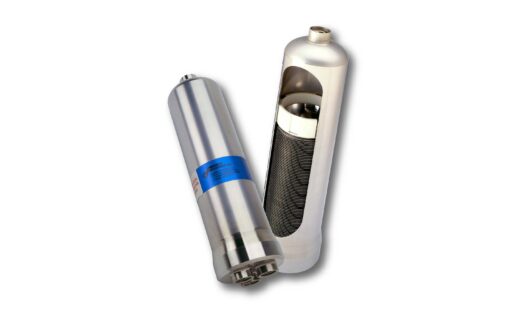
Accumulators

Our HIPRES® high-pressure maintenance-free accumulators are ideal for energy storage or pulsation damping applications for hydraulic, fuel, cooling or other fluid system applications. These metal bellows units are suitable for use on commercial and military aircraft, weapons systems, combat vehicles as well as many other platforms.
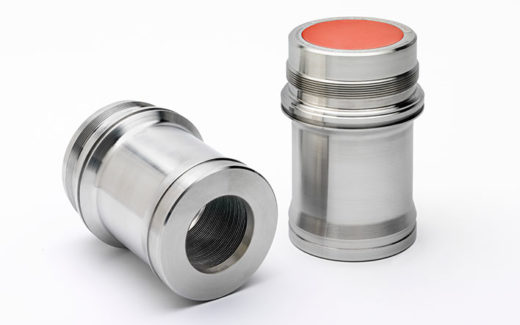
Reservoirs

The all-welded metal construction of our reservoirs eliminates leakage associated with traditional piston or bladder devices. Our reservoirs provide maintenance-free service, high reliability, and long life. These units are ideally suited for, and have a long pedigree on, commercial and military aircraft, ground vehicles and weapons systems.

Frequently Asked Questions

What makes edge-welded metal bellows accumulators and reservoirs ‘maintenance-free’?

The separator between the precharge gas is a hermetically welded bellows assembly, which eliminates precharge migration, elastomer wear, and the need for recharging—sustaining system pressure and volume over the full life of the system.

How is “zero leakage” verified?

“Zero Leakage” is verified with helium mass spectrometer testing. The mass spectrometer will pull a vacuum on one side of the assembly while helium is applied to the opposite side of the assembly. In the case of accumulators, a certain amount of helium is included in the precharge gas to enable a leak rate measurement of the sealed gas cavity.  Any helium that is able to pass through the hardware is then measured. Typical helium leak rate acceptance levels are ≤ 1×10⁻⁷ scc/sec, which is less than 3.2 scc of helium per year, and are determined based on the life requirements of the unit. Additional checks may include pressure decay, bubble tests (for non-hermetic components), and endurance testing to confirm stability over time/fatigue life. Such testing confirms the hardware will support long mission duration without attention.

Are edge-welded bellows compatible with propellants, coolants, and hydraulic fluids?

Yes, edge-welded bellows are autogenously welded metal diaphragms, so if the base material is compatible with the fluid, then so are the bellows. Properly specified bellows handle hypergolic and cryogenic propellants, glycol/water coolants, synthetic hydraulic fluids (i.e phosphate esters), and inert gases. Senior Metal Bellows engineering teams review materials for compatibility with both the system fluid and environment to ensure longevity.

How is the precharge gas, helium or nitrogen, determined?

Helium offers favorable compressibility and easy detection; nitrogen is selected when program constraints favor it. Both are supported, but Senior Metal bellows will propose the most appropriate precharge gas during a review of the application based on real gas analysis.

How does Senior Metal Bellows size and select an edge-welded metal bellows accumulator/reservoir?

The size of an accumulator/reservoir is based on the required operating parameters, which in turn impact the selection of the source of energy (i.e. gas precharge, spring, or active pressure supply). Based on this information, an engineer can:

  • Define operating envelope: dependent on the minimum and maximum system pressures, temperature range, fluid properties, duty cycle, environment (vacuum, radiation, vibration), and required volume displacement. When a gas precharge is required, Senior Metal Bellows sizes the accumulator to account for the real gas properties and performs FEA to optimize the pressure vessel geometry.
  • Determine materials & mass: Choose alloys for corrosion resistance and strength while considering weight impacts where applicable.
  • Incorporate customer desired system interfaces: Port sizes, fittings, mounting methods.
What’s the difference between an edge-welded metal bellows accumulator and a bellows reservoir?

Both accumulators and reservoirs are used to store fluid, but they have distinct applications:

  • Accumulator: Accumulators provide on-demand fluid pressure to a fluid system (like when an actuator needs to be extended), accommodating volume fluctuations and smoothing pressure pulsations to make up for the non-instantaneous speed of pumps as the fluid needs to move. They do this by having energy stored in the form of compressed gas, where the metal bellows is used to separate precharge gas from system fluid, with no gas permeation as the volume/pressure changes.


  • Reservoir: Reservoirs store fluid to accommodate continuous system volume fluctuations, but bellows reservoirs are unique from conventional reservoirs in that they also always supply energy to the system. Edge-welded metal bellows have inherent spring force, so a reservoir using this technology will constantly have active pressure on the system without necessarily needing an additional spring. When located on the low-pressure side of a fluid system, bellows reservoirs are often used to prevent cavitation of the system pump by ensuring a consistent supply of fluid and supplying a minimum input pressure. When the fluid system has a fixed volume, they may also be used as volume compensators to manage volume changes due to thermal expansion and system fluid loss, preventing over-pressurization and maintaining system pressures.

Because of their (relatively) low pressure requirements, reservoirs have reduced qualification requirements per the FAA/EASA, so a clear distinction between reservoirs and accumulators should be maintained when specifying hardware for such applications.

How is the required fatigue life of a bellows reservoir/accumulator met?

Optimized bellows geometry and alloy selection deliver high cycle counts confirmed via analysis and endurance testing.

How are temperature extremes met with bellows reservoir/accumulators?

Cryogenic to high-temp ranges are supported with material selection and geometry tuned to avoid fatigue and any potential interference caused by thermal expansion. Because no elastomers are required for the dynamic bellows seal, the temperature limits are more often determined by the system fluid than the hardware.

What accumulator and reservoir system interfaces and mounting methods are available?

While there may be existing hardware designs that are appropriate for one’s application, custom ports, mounting fittings, and brackets/ bracket interfaces can be tailored to the requirements of the system.

What documentation is delivered with bellows accumulators and reservoirs?

Deliverables are dependent on the program needs shared by the customer. Senior Metal Bellows conforms to AS9100 and provides traceability information with shipments as a default, but may also supply acceptance testing results as required, including helium leak, proof pressure, and weight results, supporting regulated or mission-critical programs. If new hardware is developed for a customer, design reviews and qualification testing is also documented and shared as appropriate. Senior Metals bellows is happy to discuss the documentation needs of a program and provide the best options to accommodate.

Design Fabrication Cost of Ownership

The Senior Advantage

  • Experience – Decades of proven service
  • Speed – Custom designs fast and right
  • Efficiency – Eliminate extraneous components (e.g. charging lines, valves, gauges, etc.)

The Senior Advantage

  • All-welded construction to highest quality standards
  • All metal (no elastomeric seals) / Choice of materials
  • Absolute zero leakage
  • No recharging required/Indefinite storage life
  • Withstands extreme temperatures/environments

The Senior Advantage

  • We “engineer-in” ultimate reliability & extreme performance
  • Zero maintenance
  • Extended lifecycles

Product Resources

Mini Accumulators for the Space Industry Brochure HIPRES Data Sheet Reservoir Tanks Volume Compensator Design Data Sheet Maintenance-Free Accumulators & Reservoirs 1-pager Coolant Accumulator and TVC 1-pager

RELATED CASE STUDIES

Business jet customer needs speed, price, and reliability

Our customer, an agile and prestigious business jet manufacturer, was developing a new aircraft for a premium market segment. They were seeking a suite of lightweight hydraulic accumulators that would provide the lowest total life cycle cost possible.

Read Case Study
1