Thermal Valves & Actuators

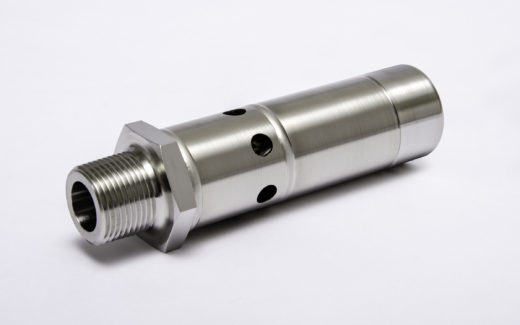
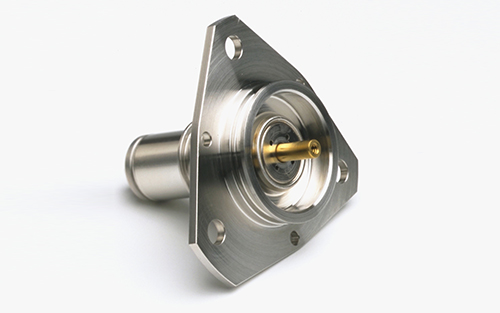
Unlike conventional devices, Senior’s thermal actuators and thermal valves use our welded metal bellows technology—which eliminates the need for elastomeric membranes. This approach allows for significant improvements in temperature tolerances, maintenance-free operation and high cycle life.

No Performance Drift

Traditional rubber membranes allow expansion media to leak, so devices experience performance drift—and eventual failure—over time. Our bellows construction means zero leakage of the expansion media, and so our actuators experience no performance drift.

Further, the welded metal bellows is capable of 1,000,000+ thermal cycles offering reliability that is orders of magnitude greater than conventional devices.
Thermal Valves

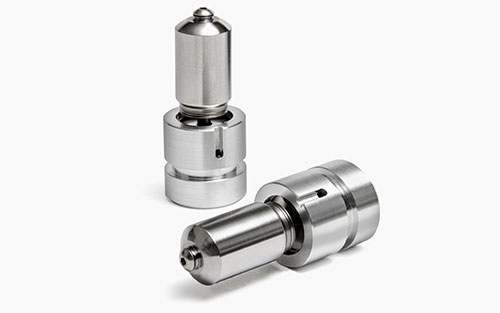
Thermal valves may also incorporate an integrated pressure relief function, factory calibrated to lift off of the valve seat at the specified “relief” temperature and pressure. The pressure relief mechanism uses a “tuned” spring that is factory-set and never needs readjustment.

How do edge-welded metal bellows thermal valves and thermal actuators work?

Within the leak-tight bellows assembly, a thermal expansion media changes its volume as the temperature of the surrounding system changes. The thermal expansion media is selected based on the desired actuation performance/temperature. The bellows, acting as an all-metal hermetic seal between the media and the system fluid, strokes to accommodate this change in volume, moving an actuator or positioning a valve component at the same time. This is a passive reaction, requiring no electric power.

How are edge-welded metal bellows thermal valves and actuators better than their elastomeric counterparts?

Elastomers struggle with fluid compatibility concerns and will degrade in extreme temperatures. In a direct performance comparison with an incumbent elastomeric solution on a large commercial aircraft engine, a metal bellows solution increased the life by more than 10x, surpassing 1 million cycles without failure and with no performance drift. Additionally, metal bellows do not create particulate, reducing strain on system filters.

How is the behavior of a thermal valve or actuator tuned?

When it comes to the stroke of the bellows, the type and volume of thermal media are the most impactful design considerations to arrive at the desired performance. Material selection for the housing and bellows, wall thickness, and diaphragm design are all considerations made when tailoring response curves as they impact how quickly the thermal media is exposed to the system temperature. When it comes to the flow and pressure drop experienced across a thermal valve, the fluid flow path geometry is also a primary consideration, requiring computational fluid dynamics (CFD) to properly analyze.

What types of edge-welded bellows thermal valves are available?

Senior Metal bellows developed our first thermal valve in the 1990s and has since gained experience producing thermally actuated spool valves and poppet cartridge valves, beyond just actuators, for numerous aerospace applications. Senior can also design pressure relief capabilities into our thermal valves.

What is the repeatability of a metal bellows thermal valve/actuator?

These devices have high repeatability with negligible stiction. Long-term set-point drift is minimized through all-metal construction, preventing thermal media contamination and leakage. There is a consistent hysteresis loop resulting from the spring force of the bellows requiring slightly more heat energy to lift-off than to return to its cool position. This delay in reaction makes the valve behave in a steady and reliable manner, as minor fluctuations in system temperature do not lead to chattering and seal wear, and limit rapid responses.

What are the temperature/environmental limitations of an edge-welded metal bellows thermal valve/actuator?

The temperature/environmental-limited component of any edge-welded metal bellows thermal valve/actuator is the thermal expansion media itself, which is selected based on the needs of the application. Successful valve/actuator testing has been performed with media at more than 800°F (430°C).

Are there any system fluid compatibility concerns with metal bellows thermal valves/actuators?

All system-wetted materials of the thermal valve/actuator are metal, so they are compatible with coolants, hydraulics, propellants, and other specialty fluids. Inconel is available where stainless steel compatibility is a concern.

What is the leak rate of metal bellows thermal valves/actuators?

The thermal media is contained within a hermetically sealed edge-welded metal bellows, so it will not leak throughout the life of the valve/actuator. Leakage of system fluid through the valve seal will depend on the type of valve and surrounding fluid parameters but is consistent with other valve technology. Senior will work with our customers to minimize the leakage through the valve seal, which can be confirmed through testing. Note, this leakage will remain consistent through the life of the part as there is no wear.

How are metal bellows thermal valves/actuators integrated into system builds?

Senior metal bellows can readily design for desired customer interfaces with ports/fittings. Because they are maintenance-free and have a self-contained passive thermal motor, they are designed for “set-and-forget” placement in restricted areas during assembly, simplifying the overall system layout.

How are metal bellows thermal valves/actuators qualified?

Typical qualification testing involves pressure testing, operational verification at temperature, and endurance testing. Depending on the life requirements of the hardware, accelerated testing procedures may be proposed. Additional tests such as impulse and vibration testing are also available and Senior Metal Bellows will review any desired qualification testing proposed by a customer.

Design Fabrication Cost-of-Ownership

The Senior Advantage

  • Innovative – Unique wax-filled design
  • Flexibility – Various wax formulas/actuation temps
  • Safety –   No membranes to fail/replace. Can include pressure-relief options, as needed

The Senior Advantage

  • Withstands harsh environments
  • Compact package
  • Performs in extreme temperatures

The Senior Advantage

  • We “engineer-in” ultimate reliability & extreme performance
  • Extended lifecycles
  • Maintenance-free operation

Product Resources

Thermal Valve/Actuator Design Data Sheet Space Thermal Management Application eVTOL Thermal Management Military Thermal Management

RELATED CASE STUDIES

Extended service life from one year to ten

The legacy design for a thermal actuator relied upon an elastomer-encased wax medium. Unfortunately operating temperature extremes rapidly degraded the elastomer, resulting in a very high rate of failure for this device.

Read Case Study

Synchronized Pneumatic Actuation

Our customer was looking to improve the performance of their wafer handling system. Their historical approach involved the use of an air cylinder and a welded metal bellows to seal the penetration into the vacuum chamber.

Read Case Study
2