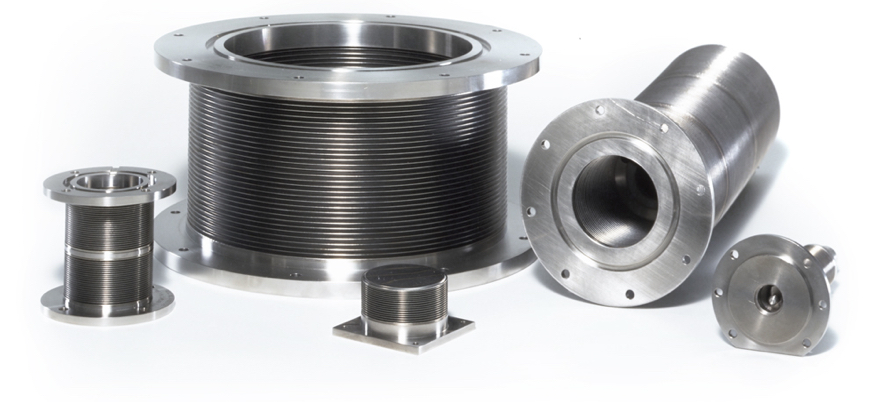
Technology

Welded Metal Bellows

An edge-welded metal bellows is a zero leakage dynamic seal capable of a great range of motion. The metal bellows is manufactured from sheet stock. The material of construction may be stainless steel, high nickel alloys, titanium or other alloys to suit the application requirements. The material thickness may range from 0.001” to 0.025” thick.


Welded Bellows Technology

  • GTAW & CO2 laser welding
  • Thickness (0.001 to 0.025 inches)
  • Sizes, diameters (0.125 to 23 inches)
  • Round and non-round
  • Materials
    • Stainless steels
    • High nickel alloys
    • Titanium
  • Mass spectrometer leak tight
    • 1 × 10⁻¹⁰ std cc/sec He capability 
(1 cc in 320 years)
  • Zero leakage dynamic seal

Bellows Performance

  • Bellows should mostly work in compression, 20% extension max. For maximum life, always work in compression
  • Nested height of bellows should have a minimum of .002” between max weld bead size for 3 ripple configuration
  • Avoid imposing lateral offset while axial stroking.  Severely degrades life
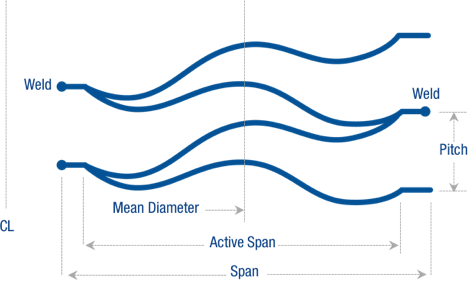
  • Max pitch 1/3 of span
  • Bellows free length will typically stabilize at 15 to 25% of as welded length

Bellows Configurations

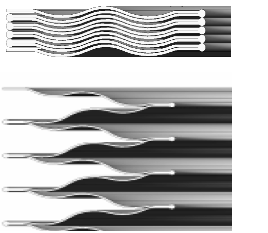
Nested Ripple

  • Long stroke capability
  • Compact nested length
  • Good linearity
  • Moderate pressure capability
  • High cycle life

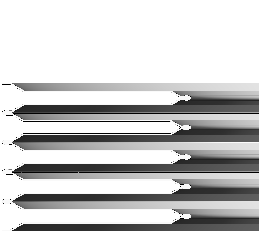
Flat Plate

  • Limited stroke capability
  • Excellent linearity
  • Good pressure capability
  • Excellent effective area control

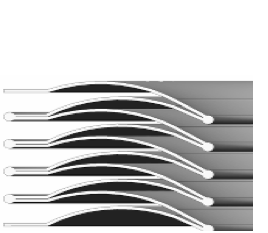
Crescent

  • Good stroke capability
  • Compact nested length
  • Good linearity
  • Good pressure capability

Welded Bellows Capabilities

Zero leakage through a range of motion in extreme operating conditions

  • Axial Deflection
  • Angular Deflection
  • Lateral Deflection

Bellows Performance Parameters

Spring Rate

  • Function of  material thickness, material type, cross-sectional geometry, pitch, span and number of convolutions
  • +/- 5% material thickness equates to +/- 10% change in spring rate in ripple geometry

Effective Area

  • 2D Area of bellows exposed to pressure differential
  • Function of OD/ID and installation geometry

Life

  • Function of deflection and pressure (membrane) stresses
  • Variables in life determination include:
    • Spring Rate
    • Pressure Differential
    • Stroke/Convolution
    • Bellows Span
    • Material Fatigue Strength

Frequently Asked Questions

What are Edge-Welded Metal Bellows?
Close-up view of a custom-engineered edge-welded metal bellows assembly, showcasing the all-metal construction and hermetic welds used for zero-leak

Edge-welded metal bellows are flexible, hermetically sealed assemblies made by welding thin metal diaphragms together at their edges. The result is a compact, spring-like structure that can extend and contract significant amounts (axial motion), flex side-to-side (lateral motion), and accommodate angular misalignment—all while maintaining an impermeable barrier from inside to out. They are often employed to manage fluid system pressures, compensate for volume changes, isolate vibration, and/or communicate motion across hermetic barriers where reliability is critical.

How Do Edge-Welded Metal Bellows Work?

Edge-welded metal bellows are constructed with a series of diaphragms (very thin metal washers) autogenously welded to the next at the inner diameter and outer diameter alternately. The geometry of each diaphragm is designed to limit material fatigue and deflection stress, even during significant axial movement of its thin wall. Because the assembly is all-metal and fully welded, it forms a complete hermetic barrier between two media (e.g., hydraulic fluid and a precharge gas in an accumulator). This fundamental design makes them the choice for maintenance-free, zero-leak applications.

How are Edge-Welded Metal Bellows Different from Formed Bellows?
Side-by-side comparison of edge-welded metal bellows vs formed bellows. The image highlights the compact stroke and high flexibility of edge-welded bellows (left) compared to the limited stroke and bulkier profile of formed bellows (right).

Versus formed (hydroformed/mechanically formed) bellows:

Edge-welded metal bellows achieve greater stroke per unit length, lower spring-rates, and better flexibility across temperature extremes. They can be built into higher assemblies that enable pressure balancing and extreme pressure differentials. While formed bellows often withstand higher internal pressure and require less touch-time to manufacture, edge-welded metal bellows offer superior performance tuning and stroke capability.

Where are Edge-Welded Metal Bellows Used?

Edge-welded metal bellows are used anytime alternative technical solutions (i.e., formed bellows, elastomeric designs) cannot meet the demands of an application for maintenance-free operation, zero leakage, or extreme environmental/system compatibility. They are commonly used in:

  • Space, Aerospace, and Defense

  • Semiconductor

  • Medical

  • Nuclear

  • Oil & Gas and other high-reliability industrial systems.

Typical applications include: accumulators and reservoirs, thermal valves and actuators, dynamic seals, volume compensators, propellant management, hermetic pumps, and ultra-clean motion control.

What Performance Ranges are Typical (Pressure, Temperature, Leak Rate) for Edge-Welded Metal Bellows Assemblies?
  • Pressure: Custom designs can support high-pressure operation (application-dependent, e.g., thousands of PSI).
  • Temperature: Broad ranges are achievable (e.g., cryogenic to > 1500°F (815°C)).
  • Leak rate: The all-metal, welded construction achieves hermeticity typically validated to a helium leak rate of ≤ 1×10 scc/sec (or better as required).
  • Cycle life: Engineered for life of the system; depends on stroke, spring rate, material, and loading profile.
Why Do Engineers Choose Edge-Welded Metal Bellows for Mission-Critical Systems?

Engineers choose edge-welded metal bellows because they deliver zero leakage, exceptionally high cycle life, and stable performance across extreme pressure and temperature ranges. They are also inherently maintenance-free, which is essential for spacecraft, aircraft, and remote or inaccessible platforms. In short: when failure isn’t an option, edge-welded metal bellows are the answer.

How are edge-welded bellows different from elastomeric seals (O-rings/Bladders)

Versus elastomeric seals (O-rings/bladders):

Edge-welded metal bellows offer broad operating temperature ranges, no stiction, excellent chemical compatibility, and no fluid permeation. They are suited to extreme environments (space vacuum, cryogenic, high-temp) where elastomers often fatigue, outgas, and/or leak. Unlike elastomeric solutions, which require routine maintenance and overhaul, edge-welded metal bellows solutions are designed to eliminate maintenance for the full life of the program.

What Metals are Used to Manufacture Edge-Welded Metal Bellows, and How are They Selected for an Application?

Edge-welded metal bellows are commonly produced from high-performance alloys, including:

  • 304L/316L/AM-350 Stainless Steels

  • Inconel 625 and 718

  • Hastelloy C-276

  • Haynes 242

  • Titanium

Selection depends on the application requirements, including:

  • Pressure and Temperature: (Strength at operating conditions).

  • Corrosion/Compatibility: (Fluids, propellants, cleaning chemistries).

  • Mass Constraints: (Titanium and high-strength alloys benefit space/aerospace).

  • Fatigue Life: (Material strength directly influences expected cycle life).

How are Edge-Welded Metal Bellows Manufactured?
  1. Stamp diaphragms from thin metal sheet.
  2. Weld pairs into a convolution with precision laser or micro-TIG (GTAW) welding.
  3. Weld stacks of convolutions into a welded bellows.
  4. Confirm weld quality with helium leak testing (often ≤ 1×10⁻⁷ scc of He/sec) and pressure proof testing as necessary.
  5. Higher level assemblies, such as accumulators and actuators, are constructed with additional assembly and welding operations as required.
How is “Zero Leakage” Verified for Edge-Welded Metal Bellows?

“Zero Leakage” is verified with helium mass spectrometer testing. The mass spectrometer will pull a vacuum on one side of the assembly while helium is applied to the opposite side of the assembly. Any helium that is able to pass through the assembly is then measured. Typical helium leak rate acceptance levels are ≤ 1×10⁻⁷ scc/sec, which is less than 3.2 scc/year. Additional checks may include pressure decay, bubble tests (for non-hermetic components), and endurance testing to confirm stability over time/fatigue life.

Are Edge-Welded Metal Bellows Compatible with Propellants, Coolants, and Hydraulic Fluids?

Yes. Since edge-welded metal bellows are constructed from autogenously welded metal diaphragms, if the base material is compatible with the fluid, the bellows assembly is compatible. Properly specified edge-welded metal bellows handle hypergolic and cryogenic propellants, glycol/water coolants, synthetic hydraulic fluids (i.e., phosphate esters), and inert gases. Senior Metal Bellows engineering teams review materials for compatibility with both the system fluid and environment to ensure longevity.

What are Common Failure Modes of Edge-Welded Metal Bellows Assemblies, and How are They Mitigated?
  • Fatigue: Minimized by proper bellows sizing and material selection. Depending on the application, Senior Metal Bellows also has various methods of limiting pressure differentials to help with fatigue life.
  • Corrosion/erosion: Prevented via material choice and careful design of sliding interfaces. The bellows itself is rarely in contact with a sliding interface, as guides are often incorporated in higher-level designs to prevent this from occurring.
  • Vibration/thermal shock: Addressed with structural supports, vibration dampening, and confirmed with qualification tests.

Inappropriate/undefined loading: Senior Metal Bellows engineers can design only for defined operating requirements. It is important that parameters in the customer’s system match what is specified to prevent premature failure and that dialogue occurs around any uncertainties in the requirements.

What customization options are available for edge-welded metal bellows assemblies?
  • Materials & finishes: Stainless steel, nickel alloys, titanium; passivation and cleanliness levels achieved per NADCAP accredited processes.
  • Interfaces: Custom ports, connectors, and mounting schemes.
  • Envelope & mass optimization: Lightweight, compact designs for aerospace/eVTOL applications.
  • Performance tuning: Spring rate, free length, and precharge optimization.
  • Testing: Modular engineering lab permits qualification and acceptance testing catered to the application/part.
How do I choose an edge-welded metal bellow supplier and start a custom design?
  • Review capability: Look for vertically integrated design-to-test process capabilities: analysis, metal stamping, cleaning, welding, NDT (including helium leak checks), as well as additional qualification and acceptance testing. Determine if the supplier has pedigree in your application that can streamline the design process.
  • Share requirements: Pressure/temperature ranges, available envelope, media, duty cycle, mission life, applicable standards, cleanliness levels, and desired interfaces. Senior Metal Bellows has data sheets for various applications where customers can find a list of critical parameters and communicate them to our engineers.
  • Consider analysis needs: Finite element analysis, flow/thermal modeling, and design trade studies (e.g., weight vs. life).
  • Validation plan: Agree on qualification matrix (leak/burst/life cycle/vibration/thermal), acceptance testing, and documentation.